
The Trillion-Dollar Rearview Mirror: Why "What Happened?" is the Most Expensive Question in Your Business
DATA TO DECISION
3/5/20263 min read


In the high-stakes landscape of 2026, there is a phrase that has become a silent tax on enterprise growth. It is a question we have all asked in Monday morning briefings, board meetings, and urgent Slack threads:
"What happened?"
It feels like the responsible thing to ask. We see the dip in customer retention, the spike in logistics costs, or the missed sales target, and we demand a root-cause analysis. We want an autopsy.
But here is the uncomfortable truth: while you are performing the autopsy, the market is moving on. In an era where 40% of enterprise tasks are now managed by autonomous agents, "What happened?" is a history lesson. And in business, history lessons are expensive.
If you want to lead, you need to stop asking the coroner’s question and start asking the architect’s: "What changes the outcome?"
The Diagnostic Trap: Are You Managing by Forensics?
Most organizations are stuck in a cycle of diagnostic analytics. We spend 80% of our talent and compute power explaining why something went wrong.
It is a relatable trap. It feels like data-driven leadership. However, diagnostic data provides context without providing a lever. Knowing that your AI missed a projection because of market volatility does not help you capture the market tomorrow. It just tells you why you lost yesterday.
The shift is not technical; it is psychological. It is moving from being a passenger who wonders why the car stopped to a pilot who knows which dial to turn to keep it flying.
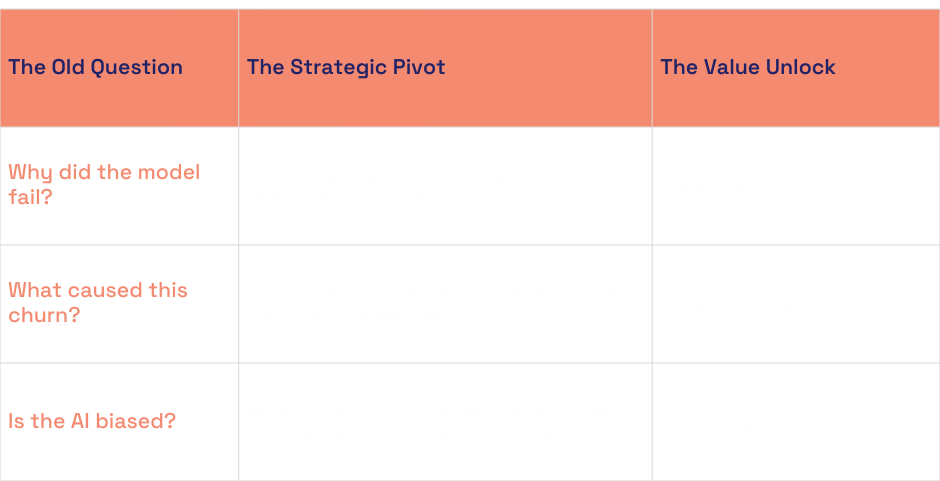
Finding Your Levers of Change
For a CEO or a department head, the goal is not to understand the math behind the machine learning; it is to identify the levers.
Next time your data team presents a report, look past the charts. Look for the sensitivity analysis. If they cannot show you how a change in Input A creates a specific result in Output B, they have not given you a strategy; they have given you a biography of your failures.
The Rule of 1%: Ask your team: "If we could move just one variable in this model by 1%, which one would result in the biggest shift in our bottom line?"
This one question forces a fundamental shift. It turns your technical team from report generators into outcome architects.
The Mid-year Reality Check
The gap between companies that have AI and companies that use AI is widening into a canyon. The winners are not necessarily the ones with the smartest algorithms; they are the ones with the shortest loop between insight and intervention.
To avoid the "What Happened" trap, start here:
Demand What-If Capabilities: If a model does not allow you to run simulations, it is not a tool; it is a mirror.
Shorten the Feedback Loop: Do not wait for the monthly post-mortem. Use real-time AI to ask what could go right while there is still time to act.
Prioritize Levers over Labels: It is better to have a model that is 85% accurate but gives you clear levers to pull, than a 99% accurate model that leaves you powerless.
Where Numel Fits in This Shift
This shift from “What happened?” to “What changes the outcome?” is exactly the gap many organizations struggle to close.
Most AI tools stop at prediction. They tell you the likelihood of something happening, which is helpful but incomplete. They rarely help leaders understand which variable to adjust, how much to adjust it, and what the specific ROI looks like if they do.
This is where Numel is designed to operate.
Instead of treating models as static, read-only reports, Numel allows decision-makers actually to interact with them. It turns a prediction into a sandbox. Leaders can adjust variables, simulate scenarios, and observe how different changes influence outcomes before a single dollar is committed to a real-world decision.
For example, instead of waiting for a monthly post-mortem, a team using Numel can test:
Revenue Impact: What happens to the bottom line if pricing shifts by 2%?
Customer Retention: How much does churn drop if onboarding time improves by 10%?
Resource Allocation: Does marketing spend or product improvement create the stronger growth lever this quarter?
Rather than waiting for results to appear in next month’s dashboard, Numel enables teams to evaluate the "What If" in advance. In practice, this means:
Testing multiple strategies before committing finite resources.
Identifying high-leverage variables that actually move the needle.
De-risking AI initiatives by seeing the ripples before they become waves.
The goal is not to replace leadership judgment with an algorithm. It is to provide a structured environment where that judgment can be tested, refined, and validated before execution.
In a world where markets move faster than reporting cycles, the advantage belongs to the organizations that can simulate, adjust, and decide before the outcome is locked in. Numel simply provides the environment where that becomes possible.