
Why Untested Assumptions are the Silent Killers of Business ROI
DATA TO DECISION
3/5/20262 min read


In the boardroom, data is often treated as the ultimate truth. For C-suite executives, the promise of Artificial Intelligence is simple: better decisions, faster scaling, and a definitive competitive edge. However, there is a hidden friction point that frequently stalls these multimillion dollar investments before they ever reach production. It is not a lack of compute power or talent. It is the weight of untested assumptions.
When we assume our data is "clean enough," our customer behavior is "stable," or our models are "neutral," we are not just taking a technical shortcut. We are incurring high interest on technical debt that eventually comes due in the form of failed deployments and eroded trust. This is where Business ROI evaporates, even if the underlying technology performs exactly as coded.
The Anatomy of an Assumption
In the lifecycle of a Machine Learning project, assumptions act as the foundation. If that foundation is cracked, the entire structure is at risk.
Most organizations fall into three common traps that prioritize technical metrics over commercial outcomes:
The "Historical Mirror" Trap: Assuming that past data is a perfect predictor of future performance. In a volatile market, yesterday’s patterns are often tomorrow’s outliers.
The "Black Box" Confidence: Assuming that if a model’s accuracy is high in a sandbox, it will perform identically in the messy reality of the real world. High technical accuracy does not always equate to high profit.
The Feedback Loop Blindness: Assuming that once a model is deployed, it remains static. Without constant validation, models "drift," leading to decisions that are objectively wrong but statistically confident.
The Commercial Impact: Beyond the Technical Balance Sheet
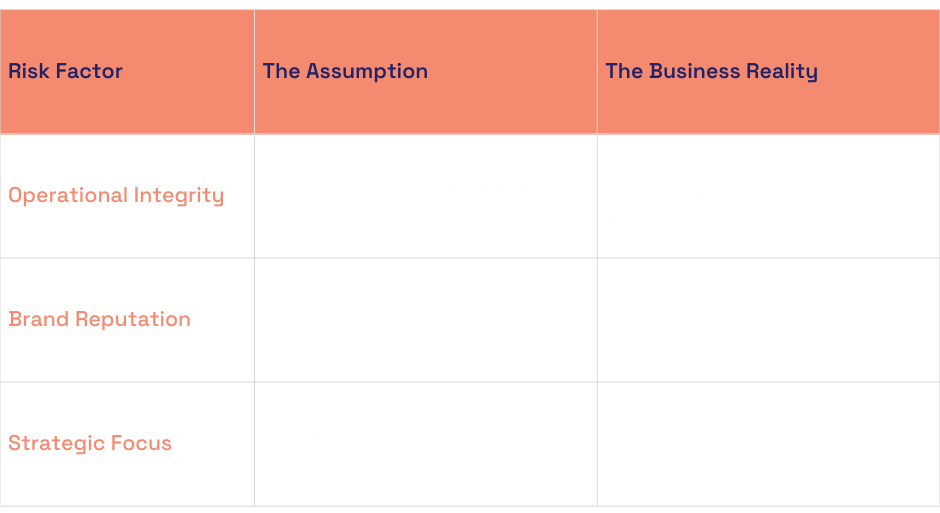
For a CEO or CFO, the cost of these assumptions manifests in ways that far exceed the initial R&D budget. True Business ROI is measured by how effectively technology translates into bottom-line growth.
How Numel Helps Organizations Validate Assumptions Before Execution
In most organizations, strategic decisions are still made on top of assumptions that remain largely untested. Market demand, customer behavior, pricing sensitivity, and operational constraints are variables often treated as constants until reality proves otherwise.
The problem is that by the time reality intervenes, the decision has already been executed. Numel was built to change that dynamic.
Instead of relying on static models or historical reporting, Numel allows leadership teams to test how outcomes shift when key variables change. Decision makers can explore alternative scenarios, adjust inputs, and observe the impact before committing resources. This allows organizations to ask critical questions earlier in the process:
What happens to projected revenue if customer demand softens?
How resilient is a pricing strategy under different market conditions?
Which operational variables materially affect profitability?
By making these relationships visible, Numel transforms AI from a retrospective analysis tool into a forward-looking decision environment. The value is not just better predictions; it is the ability to stress-test strategy before execution.
When assumptions are validated early, organizations reduce costly surprises and gain the confidence to move faster on decisions that matter.
The Path Forward
The most expensive phrase in business is "we assumed it would work." As you evaluate your current AI roadmap, ask your teams one question: What is the one thing we are assuming is true that, if false, would break the business case for this project?
If the answer is not backed by rigorous, real-time validation, your Business ROI is at risk.