
The Dashboard Mirage: Why Your Data is Great at Looking Back, but Bad at Looking Forward
AI & ML FOUNDATION
3/3/20262 min read
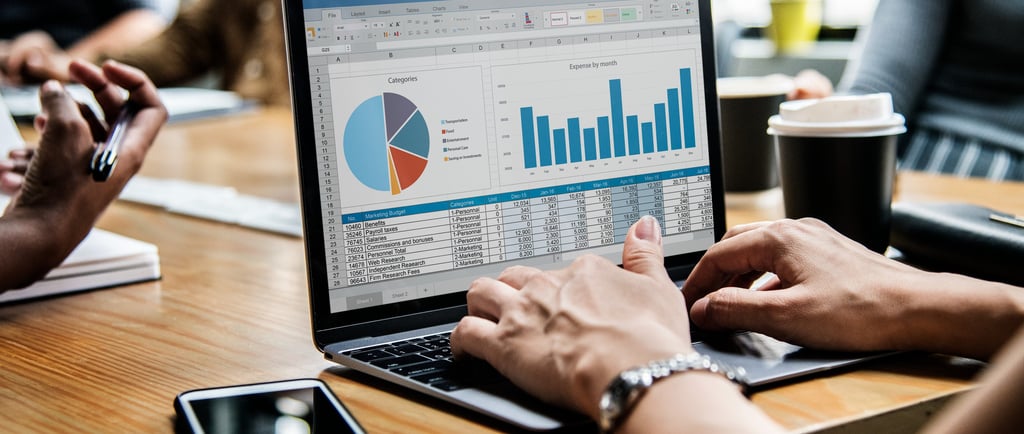

We’ve all been there: staring at a sleek, high-definition dashboard filled with real-time KPIs, glowing green trends, and crisp bar charts. It feels like you’re in the cockpit of a jet, seeing everything clearly.
But then, a stakeholder asks the "Million Dollar Question":
"What happens to our profit if we raise prices by 8% and our supply costs also jump by 12% next month?"
Suddenly, the dashboard goes silent. You click a few filters, adjust a date range, but the screen doesn't change in a way that helps. That’s because dashboards are built to tell you what happened, not what might happen.
The Rear-View Mirror Problem
Most dashboards are essentially high-tech rear-view mirrors. They are excellent at summarizing the past (descriptive analytics) and telling you where you are right now (diagnostic analytics).
However, they operate on static data. They show you the "score" of the game you just played. To answer a "What if?", you need to change the rules of the game and see how the players react. Dashboards aren't built for that; they are built for consistency and reporting.
Why Dashboards Hit a Wall
If you're wondering why your analytics suite can't simulate a market shift, here are the three main reasons:
Aggregation vs. Correlation: Dashboards aggregate data to make it readable (e.g., "Total Sales last month"). But "What if" questions require understanding how variables interact. A dashboard knows sales were high; it doesn't necessarily know they were high because a specific competitor was out of stock.
The Missing "Engine": A dashboard is a UI (User Interface). To answer a hypothetical, you need a Model, which is a mathematical engine that understands cause and effect. Dashboards display data; models process possibilities.
Linear Thinking in a Non-Linear World: Most dashboard filters are subtractive. If you filter for "Region: North," it just hides "South." It doesn't calculate how a change in the North might ripple through your entire logistics chain.
From Reporting to Simulation
To move from "What happened?" to "What if?", organizations are shifting toward Decision Intelligence. Imagine a "Sandbox" version of your business where you have a slider. You slide "Port Delay" to 14 days, and the system instantly recalculates your projected revenue, customer churn, and stock-outs.
This isn't just a prettier chart; it's a different technology stack. It uses Machine Learning to learn the patterns of your business so it can simulate a realistic future based on your inputs.
Where Numel Changes the Equation
Most organizations do not lack dashboards. They lack a structured environment to test decisions before committing to them. Numel sits in the gap between reporting and simulation.
Instead of replacing your BI stack, Numel connects to the outputs you already trust and adds a modeling layer on top. That layer allows decision-makers to move from passive observation to active scenario testing.
Using Numel, teams can:
Adjust pricing variables and immediately see projected margin sensitivity.
Model supply cost shocks and assess the downstream profitability impact.
Test churn reduction strategies before allocating marketing budget.
Simulate operational bottlenecks to understand revenue exposure.
This is not about prettier charts. It is about structured decision evaluation. Numel provides a controlled modeling environment where leaders can manipulate key business drivers (price, demand, cost, retention, inventory) and compare potential outcomes side by side. The goal is not prediction for its own sake; the goal is directional clarity before capital is deployed.
For operators: This means fewer reactive adjustments.
For finance teams: It means quantified trade-offs.
For growth leaders: It means testing levers before scaling them.
Dashboards tell you the score. Numel helps you test the next move before you make it.