The Art of Finding Patterns: Why Clustering is Your Business’s Secret Weapon
AI & ML FOUNDATION
3/6/20263 min read


In the world of data, we often talk about "Big Data" as if the sheer volume is the prize. But for a CEO or a decision-maker, data without structure is just noise. Imagine walking into a library where the books aren't organized by genre, author, or even size. Instead, they’re just in a giant pile. You know the answer you need is in there, but finding it is impossible.
This is where Clustering comes in. In the realm of Artificial Intelligence and Machine Learning (AI/ML), clustering is the technology that builds the shelves, organizes the books, and reveals the hidden connections you didn't know existed.
What is Clustering, Really?
At its simplest, clustering is a "sorting hat" for data. Unlike other types of AI that need to be told what to look for (like a dog trained to find a specific scent), clustering is unsupervised. You give it a mountain of information, and the algorithm identifies natural groupings based on similarities.
It doesn't need labels; it just looks at the behavior, traits, or characteristics of the data points and concludes that those specific things belong together.
Why Segmentation is the "So What?" of Data
You’ve likely heard the term "Market Segmentation." It’s the practice of dividing a broad target market into subsets of consumers who have common needs or priorities. Clustering is the high-powered engine that makes modern segmentation possible.
Here is why this matters for your bottom line:
Moving Beyond the "Average": If you have two customers, such as one who spends $1,000 once a year and one who spends $10 every week, their "average" spend is useless information. Clustering separates them so you can treat the VIP like a VIP and the frequent shopper like a regular.
Predicting the Unpredictable: By grouping similar behaviors, you can spot "churn" before it happens. If a cluster of users suddenly changes their login patterns, the AI can flag them for a retention campaign before they even realize they're unhappy.
Precision Resource Allocation: Why spend your marketing budget on a "one-size-fits-all" campaign? Segmentation allows you to tailor your message, your product development, and your sales efforts to the groups most likely to respond.
From Data Points to Business Decisions
Reducing the Friction: It’s Closer Than You Think
The biggest hurdle for many leadership teams is the feeling that AI is too complex or a "black box." But clustering is one of the most intuitive forms of ML. It’s essentially pattern recognition at scale.
For data teams, clustering is a foundational step that turns raw numbers into a narrative. For the C-Suite, it provides the "Who, What, and Where" needed to steer the ship with confidence. You don't need to understand the underlying calculus to reap the rewards; you just need to ask the right question: "What groups are hidden in our data that we aren't talking to yet?"
Bridging the Gap: Making Clustering Actionable with Numel
Clustering is powerful in theory, but in practice, it often gets stuck in "data science purgatory" where insights exist in a spreadsheet but never make it to the boardroom. The challenge isn’t just finding the patterns; it’s turning those patterns into something a CEO, a floor manager, or a marketing lead can actually use.
Numel simplifies clustering by providing a structured interface where teams can:
Upload or connect existing business data.
Automatically generate meaningful groupings based on behavior or performance patterns.
Visualize cluster differences in commercial terms such as revenue, churn risk, cost exposure, and engagement level.
Compare segments side by side to prioritize action.
Instead of receiving abstract cluster IDs from a data science team, decision-makers see business-relevant groupings they can interpret immediately. For example:
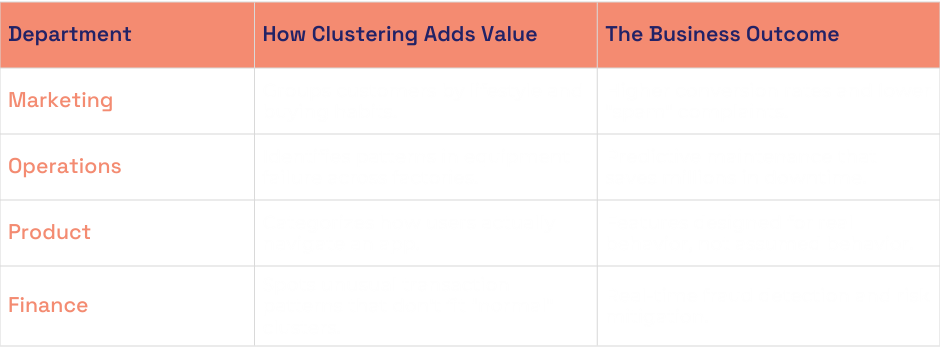
Marketing can identify high-value lifestyle segments and test targeted campaigns.
Operations can isolate recurring failure patterns across assets.
Product teams can cluster usage behavior to guide feature prioritization.
Finance can surface transaction clusters that deviate from normal patterns.
The goal is not just segmentation. It is structured segmentation with decision clarity. Numel translates clustering outputs into practical levers: who to retain, who to upsell, where to reduce risk, and where to allocate capital. It reduces the technical barrier between discovering hidden groups in your data and acting on them confidently.
The Bottom Line
In a world where everyone has access to data, the advantage belongs to those who can organize it into decisions. Numel turns clustering from an analytical exercise into an operational growth tool.