
Prediction vs. Classification: Choosing the Right "Crystal Ball"
AI & ML FOUNDATION
3/4/20262 min read


In the world of AI, we often hear buzzwords thrown around like confetti. For a leader trying to steer a company toward data-driven growth, the distinction between Prediction (Regression) and Classification is the most important one to grasp.
Think of it as the difference between asking "Which one?" versus "How much?"
1. Classification: The Great Labeler
The Question: "Which category does this belong to?"
Classification is about putting things into buckets. It’s the digital equivalent of sorting mail or deciding if a fruit is an apple or an orange. In business, this is your primary tool for risk management and customer segmentation.
How it works: The AI looks at historical data and identifies patterns that define a group. When it sees new data, it assigns a label.
Real-world examples:
Spam Filters: Is this email "Spam" or "Inbox"?
Fraud Detection: Is this credit card transaction "Legitimate" or "Fraudulent"?
Customer Churn: Is this client "Likely to leave" or "Likely to stay"?
2. Prediction: The Trend Mapper
The Question: "What is the specific value or number?"
In technical circles, this is often called Regression. Instead of picking a label, the AI calculates a specific, continuous number. This is your go-to tool for budgeting, resource planning, and growth forecasting.
How it works: The AI identifies the relationship between variables (like how "square footage" relates to "house price") and plots a trajectory to find a specific numerical output.
Real-world examples:
Revenue Forecasting: Exactly how many dollars will we make next quarter?
Supply Chain: How many units of inventory do we need to order for Tuesday?
Dynamic Pricing: What is the ideal price point for this hotel room tonight?
Which One Do You Need?
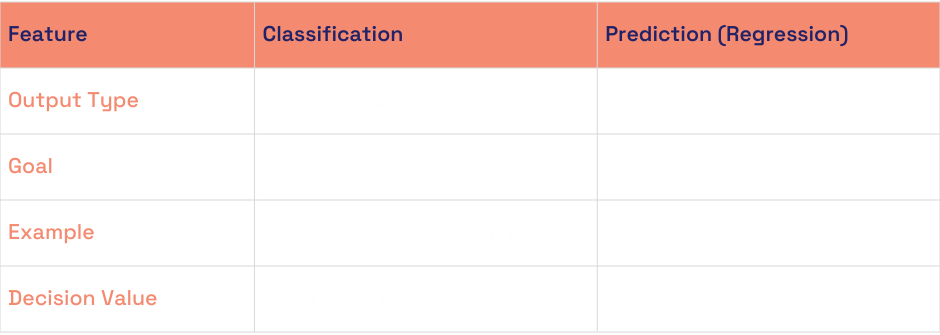
Choosing the wrong approach is like using a thermometer to measure distance—the tool is great, but the result is useless. Here is a quick cheat sheet for your next strategy meeting:
Why This Matters for the C-Suite
You don’t need to know the math, but you do need to know the objective.
If your team says they are building a "model," ask them: "Are we trying to sort our customers, or are we trying to predict a quantity?" * Classification saves you money by preventing errors (like fraud) or focusing marketing spend on the right people.
Prediction makes you money by optimizing your resources and ensuring you’re prepared for the volume of the future.
Where Numel Comes In
Understanding the difference between classification and prediction is strategic; applying them consistently is operational.
Numel enables decision-makers to deploy both approaches without needing a technical team to build custom models from scratch. It moves AI out of the "lab" and directly onto the leader's dashboard.
If the objective is Classification, Numel helps teams:
Identify which customers are most likely to churn.
Flag high-risk transactions or operational anomalies.
Segment users based on behavioral patterns.
If the objective is Prediction, Numel supports:
Revenue and demand forecasting.
Cost and margin sensitivity modeling.
Scenario testing for pricing, retention, or operational shifts.
The Advantage: Structured Evaluation
The real value is not just model access, it is structured evaluation. Numel provides a controlled modeling environment where business leaders can define variables, test assumptions, and compare projected outcomes side by side.
Instead of debating opinions in meetings, teams can simulate both "Which segment?" and "How much impact?" before capital or resources are committed.
Classification reduces preventable losses.
Prediction improves scalable growth.
Numel operationalizes both turning AI from a technical concept into a decision framework leaders can actually use.